Hixson argues that minimalism went flat because "[the runners who switched to minimalism] were either unprepared or continued to run with poor technique and didn’t reap the benefits they thought were theirs." I think this is wrong. I think it went flat because it was a trend, straight up, and trends simply don't last.
I liked Born to Run like everyone else I knew in 2009, and why not? It's a great tale of a completely insane race, and it holds out the promise of being special to every middle-aged hobby jogger out there. You have the lineage, it says. You and all human beings are to the manner born, the manner of running free and easy.
A lot of my friends -- as an educated late-20 something at the time, I was basically the target audience -- fell in love with the book. Vibrams seemed like the sensible path for a bunch of city dwellers, and away they went.
A solid majority developed stress fractures.
Now, you can say this is a case of too much too soon. And perhaps it was, although my friends adhered scrupulously to the guidelines. You can say they ran with poor technique, but the thing is, they weren't getting injured in traditional shoes. I believe that many runners could benefit from changing their running style, but the minimalist movement, or at least elements of it, seemed to argue that people should change their style solely to fit the ideal promised by a book.
If you think about it, this gets it backward. Most of us attempting to run in minimal shoes aren't naturally talented human runners, and years of sitting, injuries, weight gain, years of living have left their imprint on our bodies. For many of us, starting slowly and easing into isn't enough. Why not buy shoes that work, instead of those that fit a story?
I never went fully minimal. When I started running in fall 2013, I began by walking in a pair of Vivo Barefoot I had bought at the height of the craze. Then I ran in Altra Torins, and learned that I have better rearfoot control in a zero-drop shoe.
Unfortunately, I also learned that better rearfoot control is not good rearfoot control. My hip has to take up the slack, and while I don't have weak hips, they aren't strong enough to control a foot that developed bunions at age 13.
I'm fit. I foam roll, mobilize, everything, but I do not have good feet for running. They are fine and flexible, but trying to pretend they're really strong doesn't make them rigid. I believe the lighter shoe might have worked well, if I had different feet. No amount of toe exercises is going to change bone.
I can't believe I'm alone. I'm glad the trend happened -- it's nice to have lighter shoes, and I really like the 8mm offset Saucony adopted across the board. But the trend didn't last just because it was a trend.
Showing posts with label gear. Show all posts
Showing posts with label gear. Show all posts
Monday, March 2, 2015

Friday, January 30, 2015
Saucony Omni 12.
So, the month and a half off. I had just managed to get my SI joint under control, and I went out too aggressively at a cold Thanksgiving 5K, and followed it up with a long trail run, and then gardening, and my left thigh, hip flexor, abductors, adductors, groin, everything, just told me NOPE NOPE NOPE NOPE, and that was it.
I limped. I read Kelly Starrett's Ready to Run and Jay Dicharry's Anatomy for Runners, and both are full of helpful tips for the injury-prone runner, some of which I adopted, and some of which I'll take with a grain of salt, as you'll see,
I'm feeling better now, but minimal cross-training, some lingering stiffness, and Christmas has set me back.
Nevertheless, this week starts the training program, and a few weeks back I picked up a pair of Saucony Omni 12s on clearance. This is a monster of a stability shoe, but it has several features I like a lot.
First, they're a sharp-looking shoe. Not the most important feature, but still -- they look good.


I limped. I read Kelly Starrett's Ready to Run and Jay Dicharry's Anatomy for Runners, and both are full of helpful tips for the injury-prone runner, some of which I adopted, and some of which I'll take with a grain of salt, as you'll see,
I'm feeling better now, but minimal cross-training, some lingering stiffness, and Christmas has set me back.
Nevertheless, this week starts the training program, and a few weeks back I picked up a pair of Saucony Omni 12s on clearance. This is a monster of a stability shoe, but it has several features I like a lot.
First, they're a sharp-looking shoe. Not the most important feature, but still -- they look good.
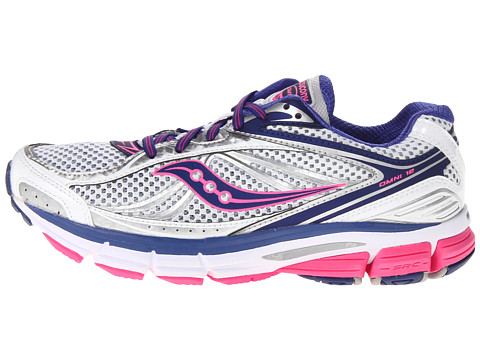
Mine are in the teal colorway, but with 50 miles on them including one very muddy trail run, they're not quite as pretty as the stock photo!
Saucony a while back decided that all of their main shoes would be 8mm drop, and I really like this feature. It is noticeable compared to my other standby, the ASICS Kayano, which has a ~13mm drop, but it doesn't feel wrong; I just notice my calf muscles working a bit more. That's good, for me, because a lower drop means my hip has to do a bit less work to stabilize my foot.
The heel doesn't flare much at all, which I also appreciate. It feels sleeker.
The feature I really appreciate, however, is this:

The shoe is very straight, and the last is very stable. After a decent amount of trial and error, I've figured out that one of my problems is that due to bunions, I have very little ability to stabilize my left foot with my toes, so a softer shoe, or one that curves leaves me with little leverage.
Now, straight lasts mean heavy motion control shoes, right? Here's the thing -- the Omnis are really light, and their ride reminds me of their Mirage, which I love (except for its durability.) So, it's a good shoe, I think, for someone like me who likes the idea of a more minimal shoe with a lower offset but doesn't yet have the strength to pull it off.
And that gets me to my last point. Starrett recommends flat shoes for runners, and working toward them. I'd wear a flat shoe if there was a stability model, but there's not, and while I completely believe that the right thing to do is work on my hip stability, the thing is, my poor hip needs all the help it can get. Sometimes I think minimalist movement forgets that the shoe is supposed to fit the runner, not the other way around, and that the shoe is one tool the runner has among many.
The Omni rides a bit firm. I prefer this -- it's easier for me to control a firmer shoe -- but I also suspect that it's designed for a heavier runner (which makes sense, given the demographics on who is likely to need a motion control shoe.) I don't feel like I sink into the cushioning at all, and it rides high.
Mostly, though, I'm just happy to finish a longer run without my hip instantly clenching, and these shoes just may be a winner....
Wednesday, August 27, 2014
It's a month away!
I ran a nice easy 4-miler with a friend today. Our half is only a month away, and from our conversation I think our feelings are mixed. On the one hand, we're both in the hardest part of our half marathon training programs, and so I think we're a bit ready to be done with training. I'm really ready for tapering just so some of my nagging non-injuries have a chance to heal.
But I have to decide which shoes I want to wear for the half:
But I have to decide which shoes I want to wear for the half:
- My workhorse Nike Pegasus 30s. I have nearly 200 miles on these now, and they're still holding up great. They're a bit squishy, however, and I find myself wondering how much energy I lose compressing the sole.
- Pros: I know I can run twelve miles in these without trashing my legs.
- Cons: I think they force more of a heel strike than I'd like, and I think they might slow me a bit.
- My Saucony Mirages. These are sort of the stability version of the Kinvara, with a plastic insert on the medial side and a stiffer, less flexible sole. They're very light and they feel fast.The uppers don't fit my feet as well as the Nikes, but I ran 6 miles at an 8:48 pace in my last race in them, and they are extremely responsive.
- Pros: Quick, light feels.
- Cons: Worried the lack of cushioning will trash my legs if my longest run in them is six miles.
So, I'm really not sure. I'm tempted to take the Mirages on a longer run, but I'm worried that I'll introduce an injury before the race.
What should I do?
Wednesday, July 16, 2014
Nike Pegasus 30 review... aka worst reviewer ever.
I honestly think one of the best reasons to up one's mileage is to have an excuse for new running shoes. Even better -- rotating running shoes (h/t: Runblogger) is linked to injury prevention. The basic idea is this: a shoe provides a surface for your foot to strike. Varying the surface by wearing different shoes (or running on different surfaces) stresses your body differently, and probably thereby reduces the risk of overuse injuries.
There are two reasons why I'll never be a great shoe reviewer:
Not bad for a hundred miles that are mostly on trails! I'm hoping they make it another 300, but 400 miles might be a bit much to expect out of a daily trainer. So far, though, if they die before the half marathon, I'd be inclined to buy another pair, which is high praise.
Still, most days, the Nike Pegasus 30 are my go-to shoes. I run primarily on roads and easy trail surfaces -- gravel, packed dirt, and grass. If I need a more technical shoe, I pick a different pair (but let's save that for another day.)
 |
| I think one has to take a weird downshot pic of one's legs in order to blog about running. |
There are two reasons why I'll never be a great shoe reviewer:
- I'm cheap, because the toddler eats all my money, so I tend to buy last year's model. So unless y'all have a time travel machine and arrived here from 2013, this is probably too late to help, especially because they're already on clearance everywhere.
- I can never determine if I like a shoe until I've put a hundred miles on it, so it takes me a while to figure out the strengths of a shoe.
Shoe reviews are so specific to the person, but I enjoy reading them because it's really just vicarious consumerism.
Anyhow, I picked these up at the start of half marathon training. Some background: I used to run in motion control shoes, because I was told I overpronate, but when I started running again last fall, I wore Altra Torins, figuring that zero-drop was interesting and that as I was a newbie I had no bad habits to break. They worked well for a while but as I began to increase my mileage, I noticed that the shoes were really too wide in the midfoot for me to feel secure in the shoe and that judging from the wear pattern I was still heel-striking. I wound up putting blue Superfeet in them to feel secure and at that point I was really defeating the purpose of the zero-drop shoe, plus, after 271 miles, they wore out.
So I went to the local running store, and their pressure mat, to my surprise, indicated that I have high arched feet with good mechanics. Apparently a lot of walking, time spent barefoot, and obsession with core has changed my gait! This is when walking, and I suspect that I have less control when running, but in any case, I figured I'd give a neutral cushioned shoe a try, and focus on making sure it had features I knew I wanted. I tried on seven or eight pairs of shoes.
Here's what I wanted.
- Solid arch support. I have high arches, and flexible feet, and I was planning to up my mileage considerably for the first time.
- Cushioning that didn't force my foot to pronate inward (ruled out the Saucony Ride)
- A relatively flexible and responsive forefoot.
- A narrow midfoot with a relatively low volume as my foot is something of a pancake.
- A wide toe box with no overlays over the bunion area. I've had bunions since I was 12, which is awful, but there you go. The only good thing about having bunions is that they work sort of like fire alarms for shoes -- I'll know within ten seconds if they won't work.
- A sole with actual rubber on it. I'd like this shoe to get me through all of half training without having to be replaced right before the race. (This ruled out the Nike Lunarglide 5, which I think I would have loved.)
- A narrow heel.
 |
| One shoe off, one shoe on... |
Things I cared about less than I thought I would:
- Weight.
- Offset. My other pairs of shoes are 4mm offset. I honestly can't notice much of a difference, possibly because the heel is so soft.
The Pegasus 30 and 31 felt great; the Pegasus 30 was on sale. To be honest I think the 30 is a little more squishy than I'd like, but I love the way it hugs my foot securely, and I'm hoping the 31 will be even better as they dropped offset by 4mm.
I'm a mild heel striker, and I don't overstride badly. I suspect as I get faster and fitter my form will improve. The 30 is great for heel strikers as there's plenty of cushion, but it has plenty of cushion for midfoot strikers, too -- I know this because I shift to the midfoot when I run hard during intervals.
Ground feel isn't superb, but the flexible forefoot is springy and I feel like I have the control I need to propel myself forward.
I run about 80% of my miles in these shoes and after 100 miles, they feel great. The soles are holding up well.
 |
| Where is the wear? |
I tend to wear down shoes at the heel on the outside and squarely under the ball of the foot, on the assumption the shoe fits well. You can see the beginnings of wear just under the forefoot:
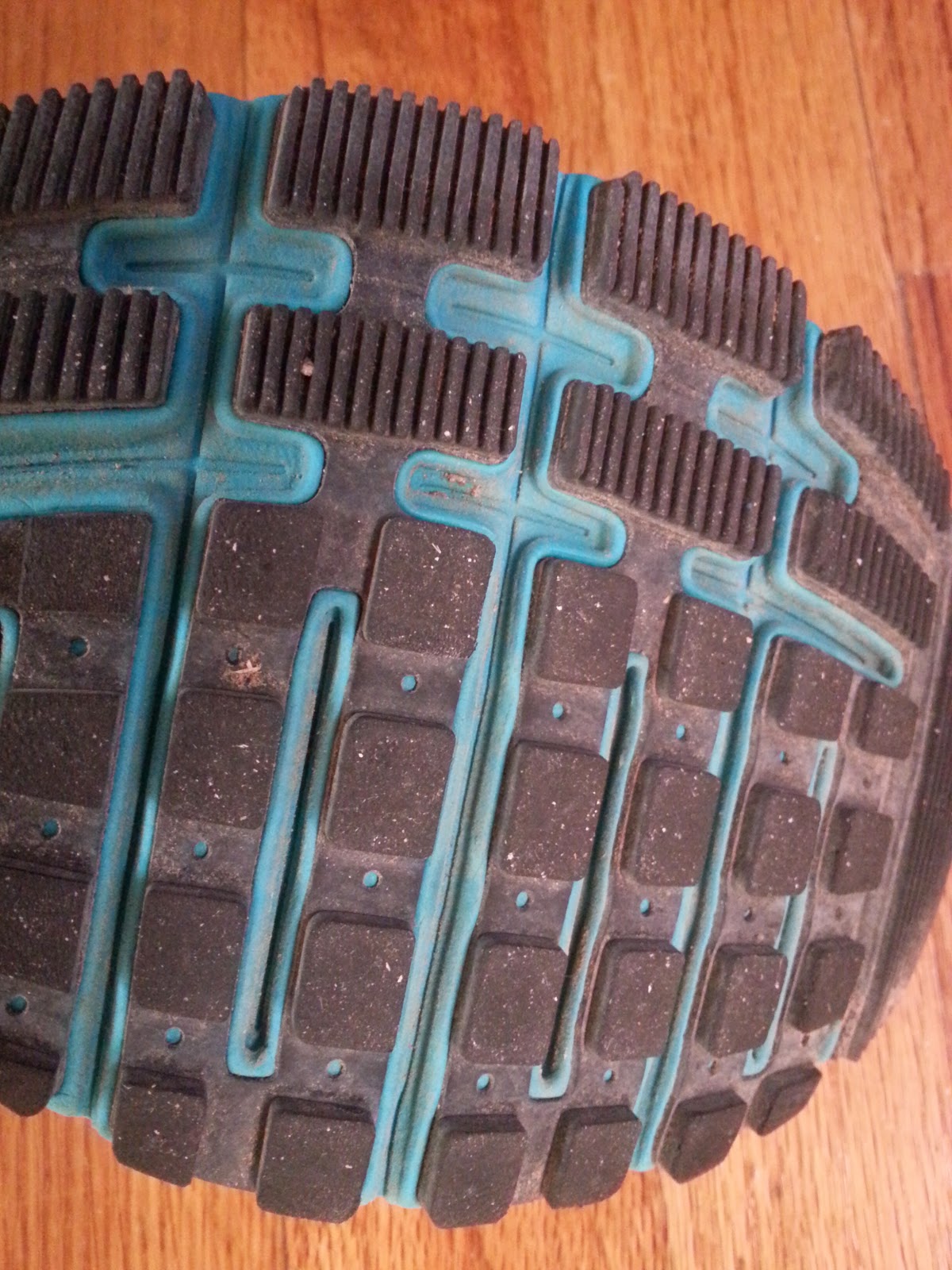 |
| Oh, there it is. |
Not bad for a hundred miles that are mostly on trails! I'm hoping they make it another 300, but 400 miles might be a bit much to expect out of a daily trainer. So far, though, if they die before the half marathon, I'd be inclined to buy another pair, which is high praise.
I get the sense from the Internet that lots of runners don't like Nike because their shoes don't fit some people well. But I have to say that if you have a relatively narrow foot and like support, this is a winner.
____
Today's strength training:
-4x6 back squat at 85%
-5 rounds: 6 push-ups, 8 two arm dumbbell presses, 8 lateral raises
- tabata: 4 minutes alternate air squats and bird dippers, 4 minutes alternate supermans and hollow rocks.
This is the sort of workout that doesn't look too bad until you realize that by rounds four and five of the push-up/press/raise circuit, every muscle in your body will be shaking. Following that up with tabatas was pure evil.
I'm a little concerned that I'm not doing traditional cardio as cross-training, but I seem to be able to complete the long runs with no problems, so for now, four days of running and two days of lifting seem to be working for me.
Subscribe to:
Posts (Atom)